
 |



| Quantity: | |
|---|---|
Power Connector
Industrial, IT Datacom
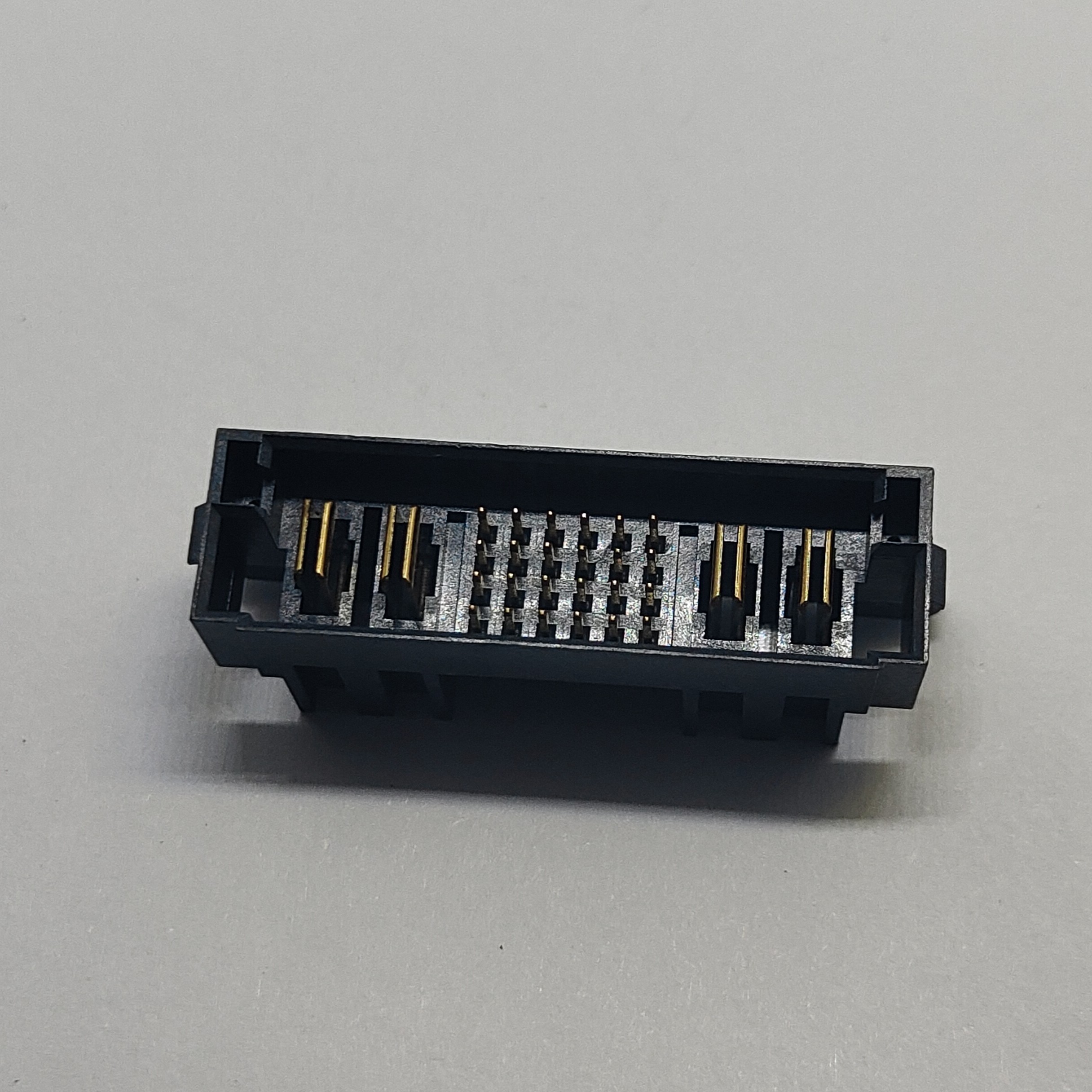
In today's compact electronic systems, board space isn't just a constraint—it's a competitive advantage. CONSHARE's combo power and signal connector solves a persistent engineering challenge: how to deliver robust power handling and high-density signaling in a single through-hole footprint, without sacrificing reliability or thermal performance.
Unlike separate power and signal headers that consume valuable PCB real estate and introduce alignment complexities, this integrated solution consolidates both functions into one precisely engineered interface. The right-angle DIP configuration further optimizes your board layout by routing connections parallel to the PCB surface, making it ideal for vertical card applications and rack-mounted systems where depth is at a premium.

The power section of this connector is designed with current de-rating in mind—something many generic connectors overlook. With 2 power contacts handling up to 28.8A, and scalable configurations available up to 8 power contacts at 22.3A per pin, the design follows a deliberate current-sharing philosophy. More parallel contacts mean lower current density per pin, reduced I²R heating, and longer contact life under sustained load conditions.
This isn't just about maximum amperage on a datasheet—it's about how the connector performs after 1,000 mating cycles, at elevated temperatures, and with real-world vibration. The selective gold plating (10μ") on critical contact surfaces ensures that signal integrity remains consistent, while tin plating on non-critical areas balances cost and solderability.
The 2.0mm pitch signal section delivers high-density interconnection without the signal integrity risks of finer-pitch alternatives. At 2.0mm, you get the sweet spot between board space savings and manufacturability—enough room for reliable PCB routing, proper solder fillet formation, and robust mechanical stability. The signal pins are positioned to minimize crosstalk with the power section, a critical consideration for mixed-signal designs where power noise can corrupt sensitive data lines.
From -55°C to +125°C, this connector maintains its mechanical and electrical properties. The high-temperature black housing material isn't just a cosmetic choice—it's selected for its glass transition temperature and resistance to heat aging, ensuring that the connector doesn't become the weak link in your high-temperature application. Whether your product lives in an industrial enclosure in summer heat or a remote sensor in winter cold, the connector's performance stays within specification.
Rated for 250V AC and 354V DC on power contacts, this connector provides meaningful safety margins for most industrial and commercial power applications. The creepage and clearance distances are engineered to meet international safety standards, reducing certification risks and compliance headaches down the line. CONSHARE designs these connectors with global market access in mind, so you can specify one part number across multiple regions.
One of the most underappreciated benefits of this connector platform is its modularity. The base design supports multiple power pin counts (1, 2, 4, 6, 8 pins per side) and signal pin counts (4, 8, 12, 16, 20 pins per row), all using the same fundamental tooling and manufacturing processes. This means you get the advantages of a semi-custom solution—exactly the pin count you need—without the NRE costs and lead times of a fully custom connector.
Power Pin Count | Current Rating Per Pin | Typical Application |
|---|---|---|
2 pins (total) | 28.8A | Low-voltage high-current supplies |
4 pins (total) | 24.7A | Redundant power feeds |
6 pins (total) | 24.1A | Multi-rail power distribution |
8 pins (total) | 22.3A | High-power systems with parallel paths |

The selective 10μ" gold over nickel plating on mating surfaces is the sweet spot for most commercial and industrial applications—excellent corrosion resistance, stable contact resistance over time, and cost-effective compared to full gold plating. For cost-sensitive applications where the connector will be mated infrequently and operated in benign environments, tin plating is also available. CONSHARE's engineering team can help you match the plating specification to your actual use case, potentially saving significant cost without compromising reliability.

The recommended PCB footprint provided with this connector is optimized for both electrical performance and manufacturing yield. Here are some design tips that experienced engineers follow but rarely see in standard datasheets:
Thermal relief considerations for power pins. The power pins carry significant current, and their solder joints can act as thermal conduits. If your PCB has heavy copper planes, consider thermal relief patterns on power pins to ensure even heating during reflow and prevent cold solder joints.
Signal pin routing strategy. Route high-speed signals on pins farthest from the power section to minimize coupling. For differential pairs, keep them on adjacent signal pins within the same row, and maintain consistent trace lengths from the connector to your IC or transceiver.
Staking holes and mechanical stability. The mounting holes on either end of the connector aren't just for physical support—they also help absorb mating and unmating forces. Use them, especially if your application involves frequent field service or blind mating scenarios.
Right-angle through-hole connectors aren't always the default, but they're often the best choice for specific applications:
Rack-mount equipment where cards slide in and out horizontally
Backplane architectures with daughtercards mounted perpendicular to the main board
Space-constrained enclosures where vertical height is limited but board edge access is available
Cable-to-board applications where the cable enters parallel to the PCB surface
If you're debating between right-angle and vertical configurations, consider both the mating direction and the mechanical stress during insertion and removal. Right-angle DIP connectors distribute mating forces along the board edge rather than perpendicular to it, which can be advantageous in high-vibration environments.
In PLCs, motor drives, and industrial I/O modules, this combo connector handles both the 24V DC supply power and the 24 signal lines for sensor and actuator connections. The high-temperature rating means it can handle the heat inside sealed industrial enclosures, and the through-hole mounting provides the mechanical robustness needed for factory floor vibration.
For line cards, switch blades, and power distribution units in telecom racks, the combination of high-current power handling and dense signaling in a single connector simplifies backplane design. The selective gold plating ensures reliable performance even in data centers where uptime is measured in "five nines."
In diagnostic and therapeutic medical equipment where both power and control signals must cross board boundaries, this connector's predictable contact resistance and stable material properties support the reliability requirements of medical applications. The high-temperature housing is compatible with common sterilization and cleaning protocols used in healthcare settings.
Bench instruments and automated test equipment benefit from the connector's signal integrity performance and current handling capacity. When you're designing a test fixture that needs to deliver power to a DUT while carrying measurement signals back to the instrument, this combo connector eliminates the need for two separate interfaces and reduces the chance of mis-mating.
A: The published current ratings are based on specific test conditions (typically 20°C ambient, still air, single connector). In your application, you'll need to derate based on ambient temperature, number of adjacent powered pins, airflow, and acceptable temperature rise. CONSHARE can provide thermal de-rating curves and application notes to help you make this calculation accurately.
A: Technically yes—the signal pins can carry low-level power. However, we don't recommend it for several reasons: the signal pins aren't sized for significant current, mixing power on signal pins increases noise coupling, and it defeats the purpose of having a dedicated power section. If you need more power contacts, it's better to step up to a configuration with additional 5.0mm power pins.
A: Selective gold plating means only the actual mating surfaces of the contacts receive gold plating—the rest of the contact (the solder tail and body) is tin-plated. This is the most cost-effective approach because gold is expensive, and you only need it where it matters: on the contact interface where electrical connection is made. Tin on the solder tails actually improves solderability compared to gold, which can cause issues like gold embrittlement in solder joints.
A: With 10μ" selective gold plating, this connector is rated for a minimum of 500 mating cycles while maintaining full electrical performance. For most applications—where the connector is mated once during assembly and rarely disconnected—this is far more than sufficient. If your application requires frequent mating and unmating (thousands of cycles), talk to CONSHARE about higher gold thickness options.
A: Yes. All CONSHARE connectors in this product family are fully RoHS compliant and meet REACH requirements. The high-temperature housing materials are halogen-free as well, supporting customers with environmental compliance targets beyond basic regulatory requirements.
Every connector that leaves our facility is built to exacting standards, but our commitment to quality goes beyond the production line. CONSHARE works with customers from the earliest design stages through volume production, providing application engineering support, sample parts for prototyping, and flexible manufacturing that scales with your demand.
When you specify CONSHARE connectors, you're not just buying a component—you're partnering with a manufacturer that understands the difference between a part that passes a datasheet test and a part that performs reliably in your actual product, year after year, in real-world conditions.


