
 |




| Quantity: | |
|---|---|
Wire to Board Connector
Industrial, IT Datacom
AR/VR

The transition to PCIe Gen5 has fundamentally changed what’s required of internal interconnects. At 32 GT/s, signal integrity is no longer a secondary consideration—it’s the primary constraint that determines whether a system can actually deliver the bandwidth its architecture promises.
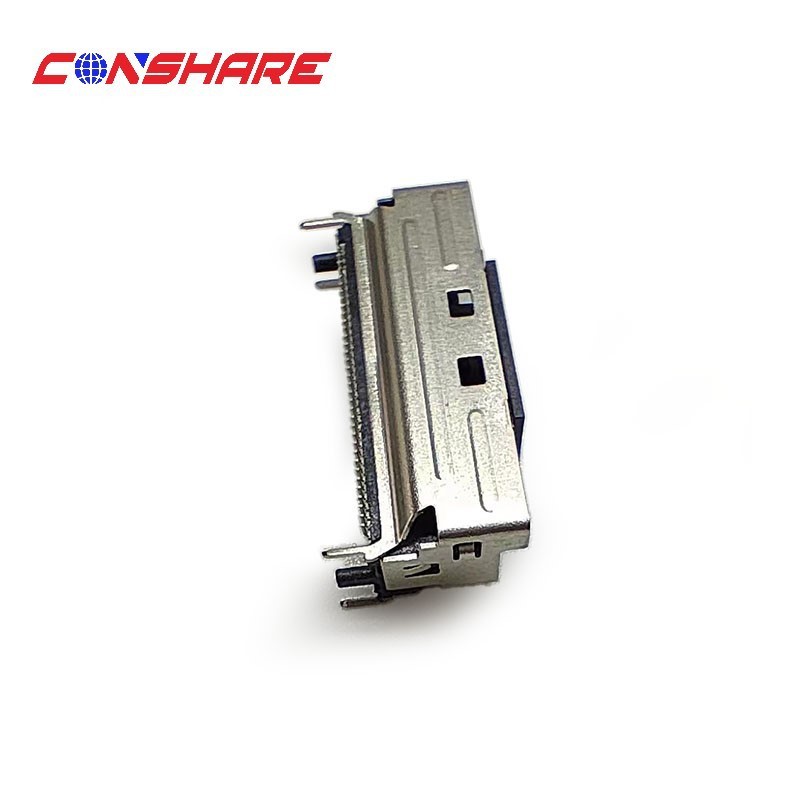
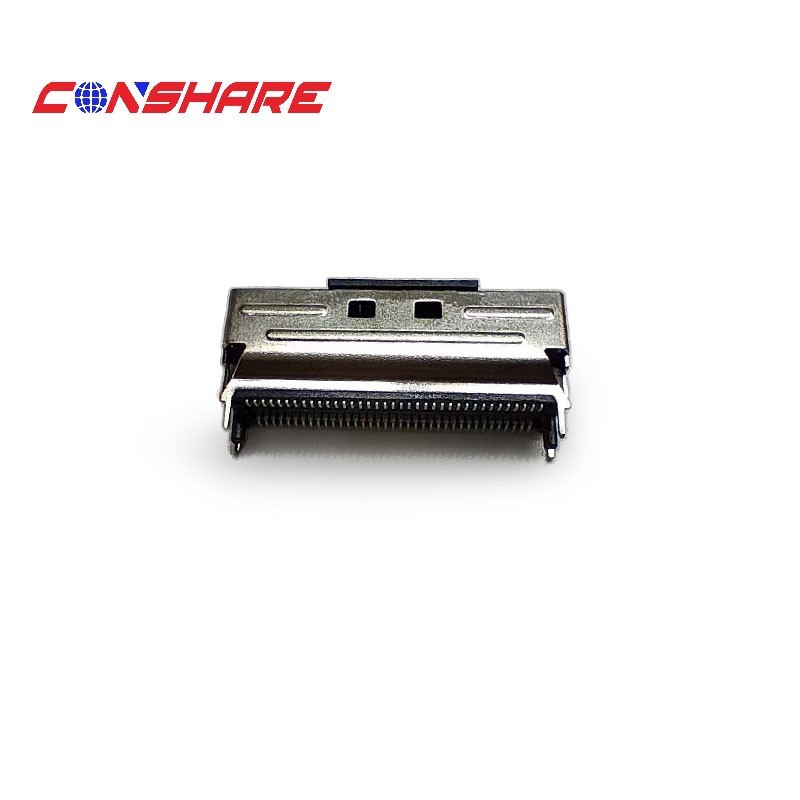
This MCIO (Mini Cool Edge IO) 74-position vertical connector is built specifically for that reality. Designed in compliance with the SFF-TA-1016 specification, it provides a compact, high-density interconnect solution that preserves signal fidelity across the channel while minimizing PCB footprint.
CONSHARE brings over 20 years of precision connector manufacturing experience to this product—combining rigorous quality management (ISO9001:2015 certified) with environmental compliance that meets RoHS and Halogen-Free (HF) standards.
Whether you’re designing next-generation servers, AI accelerators, NVMe storage backplanes, or high-performance networking equipment, this connector delivers the electrical performance and mechanical reliability your system requires.
Signal integrity at PCIe Gen5 speeds demands tight control over differential impedance. This connector is designed for 85Ω differential impedance applications—the standard for PCIe Gen5 channel designs. The 0.6mm contact pitch minimizes crosstalk between adjacent differential pairs, while the two-row layout (37 contacts per row) provides consistent electrical spacing across all 74 positions.
The contact area features 30 microinches (0.76μm) of gold plating. This isn’t just a specification number—it translates to real-world benefits:
Lower and more stable contact resistance over the product’s lifetime
Superior corrosion resistance in environments with temperature cycling or humidity
Higher durability across repeated mating cycles (rated for 200+ cycles)
Reduced signal reflection at the contact interface, critical for maintaining eye diagram margin at 32 GT/s
For systems that undergo regular maintenance, module swaps, or field upgrades, this plating thickness directly impacts long-term reliability.
The through-hole mounting style provides mechanical robustness that surface-mount alternatives cannot match. For applications subject to vibration, thermal cycling, or repeated cable insertion forces, the solder joint strength of a through-hole connector offers superior strain relief and long-term reliability.
The 2.20mm pin length provides sufficient PCB penetration for secure soldering while maintaining compatibility with standard PCB thicknesses.
PCB real estate is expensive—especially in dense server and storage enclosures where every square millimeter counts. This connector’s 0.6mm pitch allows for a high-density pin arrangement that supports 74 signals in a remarkably small package.
The board layout recommendation specifies:
Mating card thickness: 1.57mm (±0.10) —standard for PCIe riser cards and backplanes
Card slot depth: 3.25mm (±0.13) with chamfered entry (0.75mm x 45°) for smooth insertion
PCB mounting footprint designed for general tolerances of ±0.05mm
These dimensions aren’t arbitrary—they’re optimized to ensure consistent mating force, proper contact wipe, and reliable electrical connection across thousands of insertion cycles.


The black metal shell serves dual purposes:
EMI/RFI shielding – At PCIe Gen5 frequencies, electromagnetic interference becomes a significant concern. The metal shell provides a continuous ground reference that helps contain emissions and protect against external noise coupling.
Mechanical protection – The shell reinforces the connector housing, protecting the delicate contact array from damage during cable insertion, routing, and system assembly.
Environmental compliance isn’t optional for global markets. This connector is fully RoHS compliant and Halogen-Free (HF)—meeting the regulatory requirements for Europe, North America, and other regions with strict hazardous substance restrictions.

Modern servers increasingly rely on cable-based PCIe interconnects rather than PCB traces for routing between the motherboard, riser cards, and storage backplanes. This connector’s vertical orientation makes it ideal for backplane-to-motherboard and backplane-to-add-in-card connections.
High-density NVMe SSD enclosures require connectors that can handle both the electrical demands of PCIe Gen5 and the mechanical demands of frequent drive replacement. The 74-pin configuration provides 8 PCIe lanes plus sideband signals—sufficient for multiple NVMe drives in a compact space.
AI accelerators and GPU clusters demand high bandwidth and low latency between compute nodes. MCIO connectors enable flexible, modular system architectures where accelerators can be added, replaced, or reconfigured without redesigning the entire backplane.
Networking equipment benefits from the space savings and improved airflow that MCIO’s compact footprint enables—critical in high-port-density switches where thermal management is already a challenge.
At PCIe Gen5 speeds (32 GT/s), channel length has a direct impact on signal integrity. MCIO supports transmission distances exceeding 1.0 meter—significantly longer than what’s achievable with traditional PCB routing. However, best practice is to:
Place connectors as close to endpoints as practical
Avoid unnecessary cable detours or sharp bends
Consider connector orientation (vertical vs. right-angle) that supports natural cable routing
High-density MCIO deployments concentrate bandwidth and power in small areas. Design considerations include:
Keeping connectors and cables clear of heat sinks and high-power components
Avoiding cable routing across primary airflow paths
Validating thermal performance under sustained worst-case workloads
Thermal instability often manifests as signal margin reduction—problems that appear electrical but are actually airflow-related.
MCIO connectors are compact and optimized for density, not brute mechanical strength. Proper strain relief is essential:
Incorporate chassis features that support cable weight
Use cable guides or channels to control routing
Avoid tension near the connector interface
One of MCIO’s key advantages is its forward-looking design. While currently optimized for PCIe Gen5, the connector architecture is expected to support PCIe Gen6 and emerging protocols like CXL. Specifying this connector today means your platform design has headroom for future speed upgrades without mechanical redesign.
Parameter | Specification |
|---|---|
Contact Positions | 74 (2 rows × 37) |
Pitch | 0.60mm |
Mounting Type | Vertical Through-Hole |
Contact Plating | 30μ“ (0.76μm) Gold |
Differential Impedance | 85Ω |
Housing Material | High-Temperature Thermoplastic / LCP |
Shell | Black Metal (EMI Shielding) |
Pin Length | 2.20mm |
Mating Card Thickness | 1.57mm |
Current Rating | 1.1A max per pin |
Voltage Rating | 30V DC max |
Durability | 200+ mating cycles |
Operating Temperature | -40°C to +85°C |
Compliance | RoHS, Halogen-Free (HF) |
MCIO connectors are available in 38-pin (4X), 74-pin (8X), 124-pin (16X), and 148-pin (20X+sideband) configurations. The 74-pin variant provides 8 PCIe lanes plus sideband signals, making it the sweet spot for most server backplane, NVMe storage, and accelerator applications where 8 lanes of Gen5 bandwidth are required.
Yes—MCIO connectors are backward compatible with PCIe Gen4 signaling rates (16 GT/s). Specifying a Gen5-capable connector for a Gen4 system provides headroom for future upgrades without requiring a mechanical redesign.
85Ω is the standard differential impedance for PCIe applications, while 100Ω is typically used for certain SAS and networking applications. This connector is designed for 85Ω applications—the right choice for PCIe Gen5 server and storage designs.
MCIO follows the SFF-TA-1016 specification, ensuring mechanical and electrical interoperability across compliant suppliers. However, always verify pinout mapping—using a cable with incorrect pin mapping can result in non-detection, unstable links, or hardware damage.
This connector is designed for through-hole soldering with recommended hot-bar soldering process. The 2.20mm pin length provides sufficient PCB penetration for reliable solder joint formation.
MCIO supports modular, field-replaceable designs, but hot-swap capability depends on the overall system design—including power sequencing, controller support, and protocol implementation. Consult your system architect for specific hot-swap implementation guidance.


